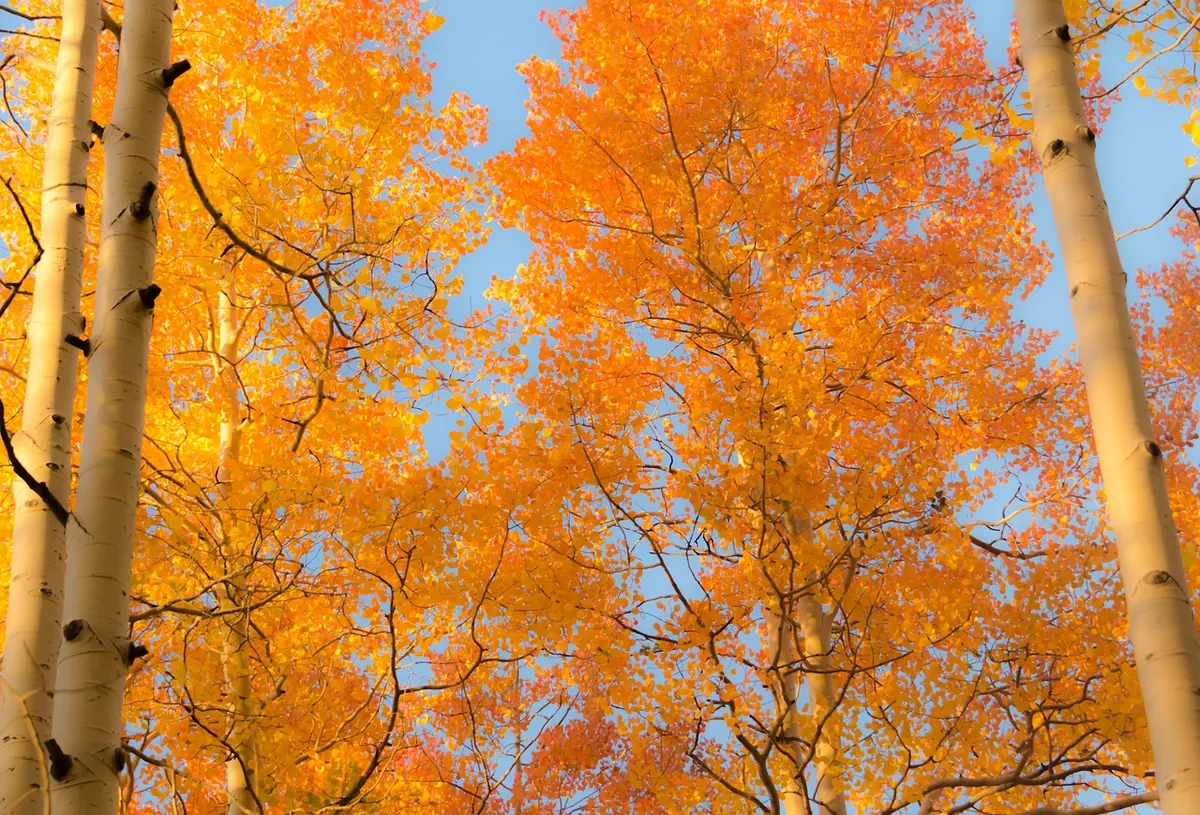

Aspens are the trees people fall in love with at first rustle. The leaves tremble in the lightest breeze — a trick of flattened leaf stalks — and in autumn the whole canopy turns butter yellow. The catch is that aspens do not stay where you put them. They spread by suckers from shallow lateral roots, and a single tree in a roomy garden can quietly become a thicket. In a small garden that is a problem worth solving before planting, not after.
The good news is that it is solvable. With the right position, a properly installed root barrier or a large container, you can enjoy that rustle without surrendering the lawn, the patio or the neighbour's goodwill.
Why aspens spread — and why it matters on a small plot
Aspen is a coloniser. In the wild it moves into open ground by sending up suckers from its roots, forming clonal colonies in which every stem is genetically identical. Those roots run surprisingly shallow and surprisingly far, often well beyond the reach of the canopy, and they keep travelling while the soil is moist and the light is good.
What happens next depends entirely on where a sucker lands. In a mown lawn it is decapitated every fortnight and usually gives up. In a border, a gravel path or a crack in the paving it will grow, and it will grow fast. That is why the same tree can be a joy in a meadow and a nuisance in a courtyard. The trick is to make your garden behave more like the meadow.
Choose the position before you choose the tree
Walk your plot with a critical eye and treat aspens as a boundary tree rather than a centrepiece. The roots will travel further than you expect, so give the tree as much clear ground as you can on at least one side — ideally the side facing open space or a neighbour's garden where you have already had a friendly conversation.
Keep aspens well away from house foundations, drains, soakaways, retaining walls, drives and paved areas. If you garden on shrinkable clay or you are unsure how close is too close, take advice from a surveyor or arboriculturist before planting rather than after. Aspens want sun — the quiver is at its best in open light — and they tolerate only light shade. They are also top-heavy and shallow-rooted, so on an exposed site stake a young tree for its first two years and then remove the tie.
One useful option in a tight plot is to accept the suckering and manage it: let the aspen form a small thicket in one corner and mow hard around it. A clump of aspen stems that you cut back every few years reads as a deliberate feature, not an invasion.
Root barriers: how to install one that actually works
What to use
Choose a rigid, purpose-made root barrier — heavy-duty recycled plastic panels or HDPE sheet — rather than a doubled pond liner or a bamboo barrier, which is far too shallow for a tree of this habit. Aim for at least 60cm of depth, and 90cm if your soil is light and sandy, where roots travel more freely.
Installing it
- Mark the line you want as the limit — usually a circle or square roughly 1.5 to 2 metres out from where the trunk will stand.
- Dig a trench on that line, to the full depth of the barrier, and set the panels vertically before you plant the tree.
- Overlap neighbouring panels by 10–15cm and join them with the clips or bolts supplied, so there are no gaps.
- Leave 2–3cm of barrier standing proud of the soil surface. Roots cannot climb over a lip; they will happily slip over a flush edge.
- Backfill firmly in layers, plant inside the barrier, mulch and water well.
Retrofitting a barrier around an established aspen is difficult: trenching cuts roots, and cut roots produce suckers. If you think you will need one, install it at planting time.
Living with the limits
No barrier is a permanent guarantee. Roots occasionally find a joint, or creep over the top if the lip silts up. Walk the line once a year, clear soil away from the barrier's edge and cut any root that has crossed. Inside the barrier, suckers can still appear, so deal with them while they are small.
Growing aspen in a container
A pot is the simplest control of all: the roots simply cannot run. The trade-off is that you take on the watering can.
Use the largest container you can accommodate — 50cm across at the very least, and 60 litres or more is easier to manage. Stand it on paving or on a gravel plinth rather than directly on soil, so roots cannot escape through the drainage holes. A loam-based compost such as John Innes No. 3, lightened with a quarter part of grit or bark, holds moisture without slumping.
Through summer, a container aspen in sun and wind may need water daily; mulch the surface to slow evaporation and never let it sit in a saucer of standing water over winter. Feed with a slow-release fertiliser in spring and a liquid feed every couple of weeks in summer. Repot every two or three years while dormant, teasing out and cutting back up to a third of the circling roots and refreshing the compost.
Pruning in late winter will keep a potted aspen to around two to two and a half metres, and it responds well to cutting back to a framework. Eventually, though, most container trees outgrow their pot; plan to pass it on, plant it out somewhere with room, or replace it.
Compact choices — and an honest alternative
- Populus tremula 'Erecta' — the upright aspen, narrow of crown and the best of the group for a small garden. It still suckers.
- Populus tremula 'Pendula' — a weeping form, usually grafted on a standard, smaller overall but no better behaved.
- Populus tremuloides — the quaking aspen, lovely foliage, and a vigorous suckerer.
Be clear about what "compact" means here: it refers to height and spread, never to root habit. Every aspen suckers. If your plot is genuinely tiny and you have nowhere to put a barrier, consider a birch, a rowan or an amelanchier instead — none of them will send up a thicket. Nothing, though, sounds quite like an aspen.
The annual sucker routine
- Late winter: dig out any sucker that has taken hold in a border, taking a piece of root with it.
- Spring to autumn: mow close around the tree. Regular mowing is the single most effective control in turf.
- Monthly in summer: walk the perimeter and pull or snip suckers at 15–20cm, when they come away easily.
- Late summer: check the barrier lip and cut anything crossing it.
- Any time: keep cutting rather than reaching for weedkiller. A herbicide taken up by a sucker travels back to the parent tree and can damage or kill it.
A workable plan for a small garden
Pick the sunniest corner with the most open ground beyond it. Mark your limit line, dig the trench and set a 60–90cm barrier with a proud lip before the tree goes in. Plant an upright cultivar, stake it for two years, mulch and water. Then treat sucker patrol as part of the summer routine — a few minutes with secateurs each month, the mower once a week, a proper check in late winter. If a barrier is not an option, pot it instead, and accept the watering.
Do that, and the aspen earns its place. You get the flutter in June and the gold in October, and your borders, patio and foundations stay exactly where they were.
Photo: Alexas_Fotos / Pixabay