
An aspen planted in reasonable ground grows quickly — often adding a metre or more in its first season — and that speed is exactly why the first few summers matter so much. The tree pushes out top growth before it has built the root system to support it. Get the watering right and you'll have a tree that looks after itself within four or five years. Get it wrong and you'll spend those same years watching the leaves curl, yellow and drop in August.
Where an aspen's roots actually are
Aspen roots run shallow and wide. Most of the working roots sit in the top 30cm or so of soil, spreading well beyond the canopy — often two or three times the width of the branches above. That has two consequences when you pick up a watering can.
First, the water needs to go into the upper layer of soil, not poured down a narrow hole beside the trunk. Second, it needs to cover a generous area. A tree watered only at its base will grow a tight little clump of roots and stay dependent on you for far longer than it should. Water a metre-wide circle around a young tree in year one, and widen that circle each year as the tree grows.
The first three weeks after planting
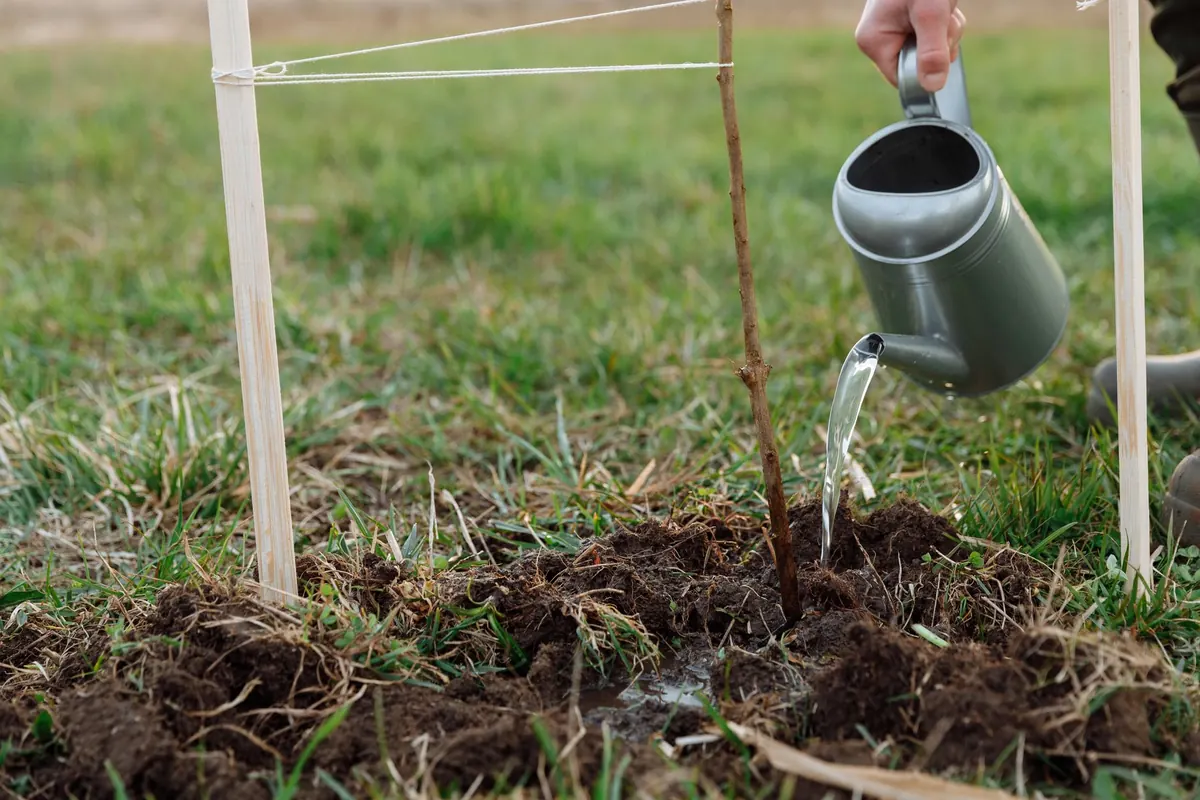
Water the tree in properly on planting day. Fill the planting basin two or three times and let it drain away slowly; this settles the soil around the roots and closes the air pockets that would otherwise dry them out.
Then keep the soil evenly moist — not sodden — for the next two to three weeks. In warm, dry weather that usually means a soak every two or three days, and possibly daily during a heatwave. If the soil is still damp 5cm down, skip it. Roots need air as much as water, and a young aspen sitting in boggy ground will rot faster than it will dry out.
A watering schedule for the first three years
Beyond the settling-in period, aim for a deep soak rather than frequent light sprinklings. Roughly, here's how the first years tend to look in a typical UK garden:
- Year one: a slow, thorough soak once a week through spring and summer whenever there's been less than about 2–3cm of rain that week. Twice weekly in hot, windy spells.
- Year two: every 10 to 14 days in dry weather, tapering as autumn arrives.
- Year three: only during genuinely dry spells — three weeks or more without meaningful rain.
- Year four onwards: nothing routine, unless the tree is on sandy, chalky or very free-draining ground.
- Winter: usually no watering at all, but check trees under house eaves, in containers or on light soil during mild, dry spells.
Aspens planted in autumn need far less from you than spring plantings — the soil stays cool and damp, and rain often does the whole job.
How much, and how to deliver it
As a starting point, a young tree in its first year wants somewhere around 10 to 15 litres at each watering — enough to wet the soil to roughly a spade's depth across that metre-wide circle. A quick splash from a can does nothing except dampen the surface, which encourages shallow rooting and makes the tree more vulnerable, not less.
A few habits make the job easier:
- Water in the early morning or early evening, so less is lost to evaporation.
- Use a soaker hose, or stand a bucket with a small hole drilled near the base and let it empty slowly over an hour.
- Mulch with 5–8cm of bark chip or well-rotted compost, pulled back a hand's width from the trunk. It cuts evaporation dramatically and keeps the soil cooler.
- Check before you water. Push a finger or trowel 5cm into the soil. Damp? Walk away and come back in a few days.
Reading the leaves: too little water, and too much
Aspens are unusually expressive about water. Learn the signals and you'll rarely need to guess.
Signs of drought stress
Leaves curl and roll inwards, often with crisp brown margins. The foliage loses its bright shimmer and turns a dull grey-green. Leaves may wilt in the afternoon and fail to recover overnight — that's a clear message. Premature yellowing and heavy leaf drop in August, while the tree still looks otherwise healthy, is another common sign that the roots are running dry.
Signs of overwatering
Yellowing that starts low down and works upward, soft or blackened root tips, a sour smell in the soil, algae or moss on the surface, and wilting despite ground that is obviously wet. If you're seeing those, stop watering entirely and let the soil dry out for a fortnight. On heavy clay, it's easy to overdo it.
Weaning the tree off irrigation
The goal is a tree that finds its own water. The trick is to water less often but more deeply each year, which gently pushes roots downwards and outwards instead of letting them loiter near the surface.
From year three, start stretching the intervals: 14 days instead of seven, then three weeks, then only when the soil is dry at 10cm. By year four or five, most aspens on decent loam in a normal British summer need no routine watering at all. Sandy or chalky soils are the exception — there, plan on occasional deep soaks in dry summers for several more years, and keep the mulch topped up.
A rule of thumb worth remembering
Deep, wide and less often. Water the soil, not the trunk; check with your finger before you reach for the hose; and follow the weather rather than the calendar. If you only do one thing, mulch generously and soak the root zone properly every week or so through the first two summers. An aspen that has been watered well while young will reward you with the one thing it does better than almost any other tree — movement, colour and a fast, generous canopy for decades afterwards.
Photo: Thirdman / Pexels